The 12th Securities Services Conference organised by Cecabank addressed key issues such as the regulatory framework for stablecoins, asset tokenisation, the evolution of the ETF market in Europe, and the role of venture capital in financial markets
Carlos San Basilio, President of the CNMV, and Soledad Núñez, Deputy Governor of the Bank of Spain, participated in the meeting, providing the institutional perspective on the challenges faced by the industry and the evolution of the markets
Cecabank has highlighted its activity in the custody of crypto assets, the progress towards T+1, the launch of its securities lending agency and the opening of its branch in Luxembourg as strategic priorities
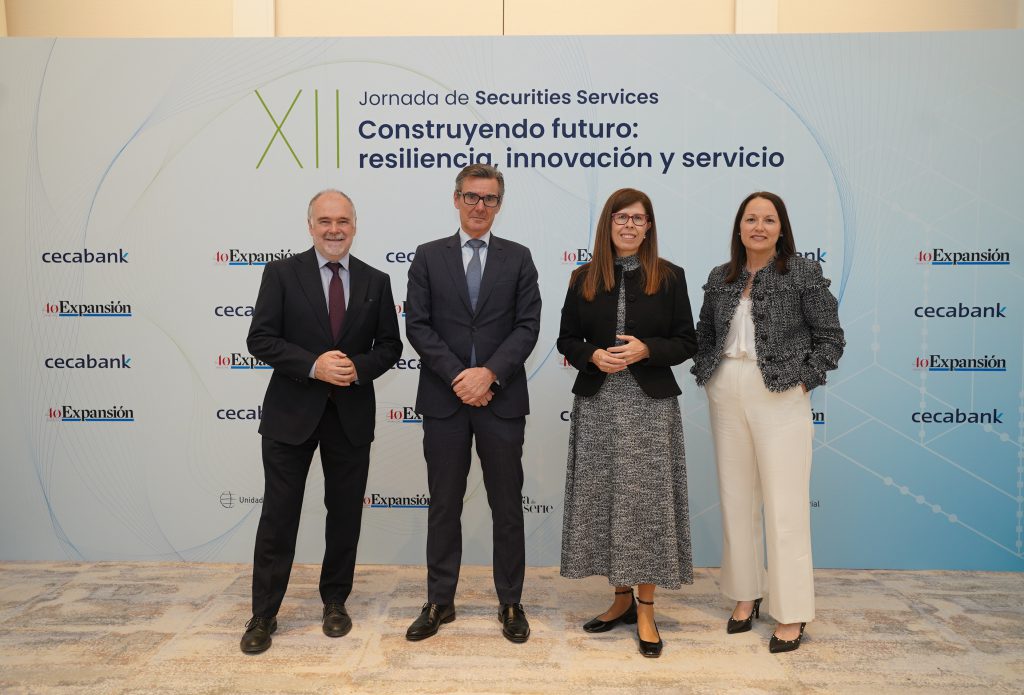
Marked by the structural transformation of financial markets and by increasing operational, technological and regulatory complexity, the post-trade sector is facing a decisive moment. Strengthening the system's resilience, promoting innovation, and providing increasingly specialised services position post-trading as a key pillar for the stability and efficiency of financial markets. In this scenario, dialogue between the various actors in the industry is essential to anticipate challenges and build shared responses.
With this objective, Cecabank held its 12th Securities Services Conference today under the motto “Building the future: resilience, innovation and service.” A consolidated meeting as a forum of reference of the sector, that has gathered to nearly 300 representatives of more than 100 companies of the industry of the postcontracting —entre financial institutions, managers, regulators, supervisors and companies tecnológicas—, to analyse the trends that they will mark its evolution in the next few years.
The event also had the honour of featuring an opening address from Soledad Núñez, Deputy Governor of the Bank of Spain, who highlighted: “Our intention is to lay the foundations to enable a progressive transition in Europe towards a more digital and integrated financial ecosystem, ensuring that any evolution towards tokenised capital markets occurs in an orderly manner.”
The Deputy Governor of the Bank of Spain was accompanied at the opening by Iñaki Garay, Deputy Director of Expansion, and by Ainhoa Jáuregui, CEO of Cecabank, who emphasised: “At Cecabank we face up to the challenges of the industry from a position of strength, supported by a solid B2B business model and a firm commitment to the sector. We are the leading depositary bank and a benchmark in custody in the Iberian market, backed by an international structure with branches in Lisbon and Luxembourg and a clear commitment to serving our clients.”
The twelfth edition of the conference structured its programme around the main vectors of transformation in the sector, addressing technological innovation, regulatory evolution and the impact of new investment models on market infrastructures and post-trade services.
The day began with a strategic reflection on the role of stablecoins in the financial ecosystem, in a dialogue between Ernesto Olmedo Pereira, Head of Strategy & DeFi at Qivalis, and Aurora Cuadros, Corporate Director of Securities Services at Cecabank. The debate focused on its regulatory fit and the potential implications for operational efficiency and risk management, as well as the challenges associated with its progressive integration into traditional post-trading flows.
Next, Iñaki Varela, Deputy General Manager of Media at Kutxabank Investment, Marta López, Director Head Relationship Management Europe at Euroclear, and Daniel Zaplana, Director of Operations at TREA Asset Management, offered their views on the post-trading in the Spanish market with special attention on the coordination between entities, infrastructures and managers. The session was moderated by Óscar Mateos, Director of Securities and Current Accounts at the Securities Services Division at Cecabank.
The next panel discussion focused on analysing the progress of tokenisation as one of the key elements in the evolution of financial markets. Artur Callau, Corporate Innovation – Digital Assets at CaixaBank, Amparo García, General Manager of Securitize Europe, Carlos Matilla, CEO of ioBuilders, along with Virginia Linares, Director of Coordination and Control of Securities Services at Cecabank, reviewed the main use cases and their impact on post-trade services.
The event continued with a presentation by Silvia Senra, Head of Digital Distribution at BlackRock Iberia, who offered an expert perspective on the evolution and trends in the ETF industry in Europe. During her speech she analysed the growth of this segment, product innovation, the transformation of distribution models and the growing role of ETFs in investment strategies, both institutional and retail.
The day concluded with an analysis of the role of venture capital as a lever for innovation and growth in the financial markets, with the participation of Miguel Cacho, financial partner at Arcano Capital, Borja de Luis, Managing Director and Head of Alternatives & Infrastructure at Dunas Capital, and Carlos Conti, partner at Inveready. Moderated by Fernando Toledano, Business Development Director of Cecabank, the session delved into its contribution to the evolution of investment strategies, project financing and the configuration of new business models within the financial ecosystem.
The closing speech was carried out by Carlos San Basilio, President of the National Securities Market Commission (CNMV), who has called for the entire sector to prepare to move to T+1, now that the decisive moments are arriving, and he highlighted: "This time there is a tailwind and pressure from public opinion for us to move towards a true integration of European markets."
The final word went to Aurora Cuadros, Corporate Director of Securities Services at Cecabank, who emphasised: “In recent months, Cecabank has promoted a series of strategic milestones aimed at strengthening support for its institutional clients and anticipating changes in the market. These include the opening of our branch in Luxembourg, obtaining the MiCA licence to provide cryptocurrency custody services, progress in the transition to T+1 in coordination with the market as a whole, and the launch of a securities lending agency to facilitate this process within collective investment institutions.”
Cecabank, a specialised B2B model that boosts the resilience of the financial system
For more than a decade, Cecabank has played a crucial role in providing the infrastructure that contributes significantly to the long-term security and stability of the financial system. This value is underpinned by a B2B model based on neutrality, operational reliability and specialisation, which is reflected in three business lines: Securities Services, Payments and Treasury Management.
In post-trading, Cecabank rigorously and independently protects the savings of nearly ten million participants and again reached record figures this year in deposit and custody volumes, consolidating its position as a leader in Security Services.
In the field of depositary services, Cecabank maintains its position as a leading depositary bank in Spain, providing services to over 50 asset management companies of collective investment undertakings, pension funds, EPSVs and private equity entities. With a deposited portfolio of almost €300 billion, distributed across nearly a thousand investment vehicles, the breadth and diversity of the entity's depositary activity is more than evident.
In custody services, the bank continues with sustained growth. The total volume of assets under custody exceeds €400 billion, managed for more than 135 financial institutions and with access to more than 70 international markets, reflecting a robust operating platform with a strong global reach.
With this track record, the bank has been recognised for the tenth consecutive year as the best custodian bank in Spain, by the specialised magazine Global Banking and Finance Review. This confirms its industry leadership and the trust that customers place in its independent business model.
The strength of the model is also reflected in a CET1 ratio of over 52% at the end of 2025, one of the highest in the Spanish financial system, which supports its ability to continue investing in technology, operational resilience and innovation.