Cecabank consolidates its Payments Conference as a leading forum in the sector, bringing together 200 representatives from more than 145 entities to analyse the major drivers of payment transformation in Europe
Payment interoperability, the emergence of new digital currencies, and an increasingly fragmented geopolitical environment were the topics discussed at the meeting
Cecabank strengthens its role as a pan-European B2B payments infrastructure, driving technological innovation to facilitate safer, more efficient and borderless payments for its customers, in line with the move towards an increasingly integrated European payments market
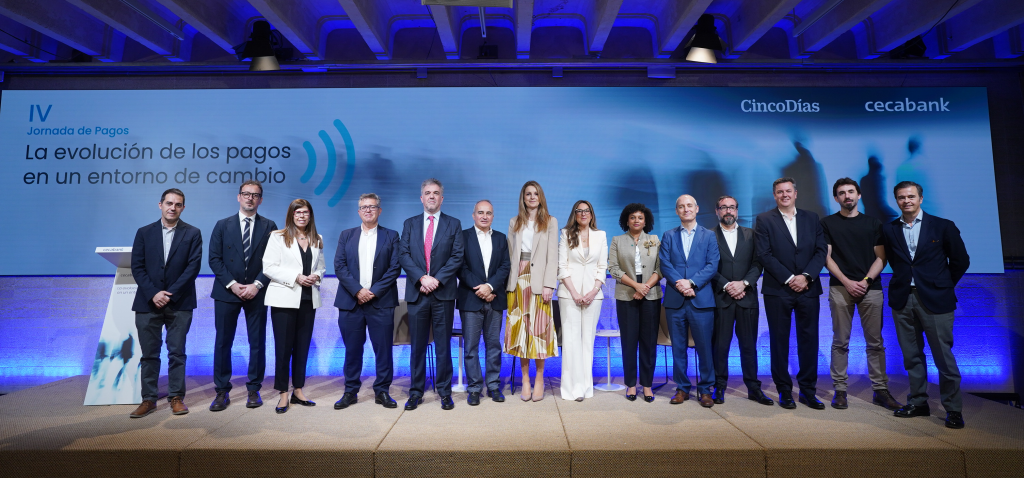
The payments ecosystem will reach a turning point in 2026, driven by the full implementation of instant payments at the European level, increasing regulatory pressure on operational resilience, and the emergence of new payment instruments and business models around them. This context demands more robust, interoperable and secure payment infrastructures, capable of operating in real time and with homogeneous standards throughout Europe. Against this backdrop, Cecabank, a leading wholesale bank specialising in financial and technological services, today held the 4th edition of its Payments Conference under the slogan "The evolution of payments in a changing environment".
The event brought together more than 200 professionals from over 145 entities and reinforces its position as a leading forum for the payments ecosystem. Throughout the day, the sector addressed, from different perspectives, the main vectors of transformation in payments, analysing the growing interconnection between the domestic and international spheres, the advance of digital currencies, the challenges of interoperability and the impact of technological, regulatory and geopolitical factors on payment infrastructures.
The conference was opened by Ainhoa Jáuregui, CEO of Cecabank, and Nuño Rodrigo, Deputy Editor of Cinco Días. The CEO of Cecabank, Ainhoa Jáuregui, emphasised that “payments cannot be understood from a singular perspective. No single actor, however large, can encompass the complexity of the current ecosystem on its own. Today, more than ever, cooperation and partnerships are the true engine of innovation and resilience”, to which she added: “At Cecabank, as a wholesale bank specialising in payments, we reaffirm our commitment to the transformation of the ecosystem, actively participating in the strategic projects that will shape the future of payments in Europe, supporting entities in their modernisation and adaptation processes, and collaborating closely with supervisors and regulators to contribute to a solid and coherent framework.”
In the first round table, Mónica Campanet, Head of Operations and IT at Bizum, Alberto González, CEO of EURO 6000, Juan Luis Encinas, CEO of Iberpay, and Luis Álvarez-Cascos, STMP's Director of Marketing, Business and Innovation, analysed the progressive connection between the domestic and international spheres, focusing on the need to move towards increasingly interoperable and scalable models. From the perspective of the main infrastructures and solutions of the ecosystem, the operational and strategic challenges of cross-border expansion were addressed, as well as the role of European platforms in building a more competitive and secure payments market. The discussion was moderated by Nuria Mohedas, Director of Payments and Digital Banking at Cecabank.
Next, Andrea Fiorentino, Head of Solutions Global Clients at Visa, and Susana Rubio, VP Products and Solutions Lead at Mastercard—in their capacity as global networks of intermediation and payment processing on an international scale—participated in a debate moderated by José Manuel Domínguez, director of Card Payment Services at Cecabank. Throughout the debate, they shared their vision on adapting international payment solutions to the particularities of each market and the need to harmonise the user experience without losing efficiency or security, using new technologies such as AI agents.
The debate continued with an analysis of the impact of new digital instruments on the evolution of the financial system and, specifically, on means of payment. Moderated by Julio César Fernández, Director of Business Development and Operations Support at Cecabank, the session included the participation of José Manuel Marqués, Director of the Market Infrastructure and Innovation Department of the Bank of Spain, Gloria Hernández, Partner at Finreg 360, and Leif Ferreira, founder and CEO of Bit2Me. During the discussion, key issues in the field of digital currencies were addressed—including cryptocurrencies, stablecoins and the digital euro—as well as its implications for the adoption of new payment models and its influence on financial services.
The conference continued with an analysis of how the macroeconomic and geopolitical context is shaping the evolution of the payments industry. Moderated by Juan José Gutiérrez, Corporate Director of Payments at Cecabank, the session included the participation of Francisco Rodríguez, Director of the Financial and Digitalisation Department at FUNCAS, and Gorka Briones, Strategy and Innovation Partner at Deloitte, who provided their vision on the challenges of the industry in an environment marked by increasing geopolitical fragmentation, the need to strengthen the resilience of infrastructures and the advance towards greater European strategic autonomy.
As a closing to the day, Juan José Gutiérrez, Corporate Director of Payments at Cecabank emphasised that “forums like this one are key to analysing, from a strategic perspective, the profound changes that the payments industry is undergoing. At Cecabank, we work every day alongside financial institutions, supporting them in their daily needs, regulatory adaptation, and the evolution of technology and infrastructure. This commitment translates into continuous investment in resilience and innovation, fundamental pillars of the new payments model.”
Cecabank strengthens its role as a pan-European B2B payments infrastructure
In the payments sector, Cecabank continues to establish itself as a key infrastructure provider for the industry, strengthening its capabilities, diversifying its solutions and supporting its clients in their digital transformation processes. As a specialised B2B provider, the entity offers flexible and innovative solutions for processing card, account, e-commerce and mobile payments, as well as advanced technology platform services, including digital banking and electronic invoicing solutions.
With a presence in 13 countries and a base of more than 300 national and international clients, in the last financial year Cecabank managed a total volume of transactions exceeding €2.42 billion, of which more than €1.859 billion corresponded to card transactions and €189 million to Bizum transactions between individuals, reflecting its high operational relevance and its ability to keep pace with the evolution of payments in Europe.
Over the past year, the bank has decisively fostered technological innovation, facilitating safer, more efficient and borderless payments, in line with the progress towards a fully integrated European market. In this context, it has deepened the implementation of solutions from major international schemes, expanded the functionalities of Bizum—with growth in e-commerce and cross-border payments within the framework of the EuroPA project—and implemented the functionality of verification of payee (VoP) in transfer operations for its transfer clients in Spain, Andorra and Luxembourg.
The offering is rounded off with comprehensive solutions across the entire payment value chain, including value-added services and currency exchange solutions for international payments—via Global FX Payments—as well as dynamic currency conversion at retail outlets and ATMs, supported by advanced AI technologies. Cecabank thus reinforces its role as an enabler of the payments ecosystem, facilitating the settlement of transactions for clients who are not direct members of national and European clearing houses.